Photo by Alex Wu
I have always been a very confident ballpoint pen.
Well, I’ll start a little further back, with a less concerning (albeit nerdier) statement: I have always been a very confident ballpoint pen user. In middle school, I used up multiple Paper Mate InkJoy pens, the ink bright and thick like liquid Skittles, and I progressed in high school to the more practical Pilot Acroballs, with their simple design and comfortably textured grip. In college, my best friend gifted me a set of 0.38mm Pilot Juice pens, which won me over with their smooth, impossibly thin writing capabilities.
Through all these phases, though, my loyalty to the pen type itself never wavered. And why should it? Ballpoint pens are everywhere for a reason — they write evenly, dependably, each stroke identical to the last. Unremarkable but consistent, they are ideal tools for everyday life, contributing to class notes, grocery lists, rent checks, and any other small task that might arise. Even apart from the organized lifestyles they enable, their inherent feel and flow provide a sense of purpose and productivity. There's always been something soothing to me about the stability of a good ballpoint pen.
I’ll even admit that, in the past, my admiration for these qualities has bordered on obsession. While navigating my academic career and its many pen phases, I have found myself modeling habits after the pens I so enjoy — maintaining a uniform, tidy existence, prioritizing utility, and staying relatively self-contained. One could dismiss these tendencies as typical to a Type-A oldest child. Truthfully, though, I also attribute them to a hyperfixation on my own limits. I dread the fact that, like a ballpoint’s ink, my time and energy will run out if I operate irresponsibly, leaving me as useless as a plastic pen shell. My subconscious tells me that such a life would be unbearable, so I build my routines around efficiency and sustainability.
Until recently, I never questioned this mindset, or whether God actually agreed with my subconscious on the necessity of it. I was entirely satisfied with my ballpoint pen life. It was monotonous at times, maybe, and mentally exhausting at others — but it was safe.
This lack of perspective is unwarranted, in hindsight, considering how early on I discovered that it wasn’t really safe at all.
When I was ten years old, after a childhood spent in church with relative indifference, a Christian summer camp taught me what it truly meant to rely on God rather than myself. The very first night saw a room full of kids, excited for a week of fun, ready to experience the euphoric rush of worship and powerful messages. I, an anxiety-wracked, routine-reliant, obsessive germaphobe, was not one of them. I was in the back of the room, already fighting off a panic attack, because a girl in my cabin had a stomachache.
As funny and pitiful as it seems now, at the time, I felt so trapped I could barely function. I had no familiar places, faces, or routines to give me any sense of security, and all I could think about was going home.
Nor did it get much better throughout the week. My fear of the unpredictable, already crippling, was compounded by guilt — I knew I was supposed to be having fun, doing activities, and making friends, but I could not bring myself to engage. I had never felt so helpless, or so useless. At last, I was confronted with the problem of being a ballpoint pen: when you come to the end of yourself, you come to the end of everything.
If you’ll follow the metaphor a bit further with me, while we may not all have such strong ballpoint pen personalities, we all resemble them to some degree from birth. Our hearts carry countless limitations - whether that be mental, emotional, or spiritual. Take the virtue of peace, in my case. While all humans can experience it, as a signature of our Creator, our fallen natures can make it feel very difficult at times. Worse still, if we subtract God from the equation, there’s nothing we can do about it. Our primary purpose becomes simply to maximize happiness, minimize suffering, and keep our fragile, individual lives afloat. In stark awareness of our own finitude, we become enslaved to a nagging sense of self-preservation and scarcity, the constant fear of giving too much away, too much time or love or money. Even community gains a tragic sense of transaction: “I’ll support you, but I expect you to support me.”
From a practical standpoint, this survival mindset may seem like common sense to those who do not know Christ. We hear countless quotes from the self-focused world around us: “Pull yourself up by your bootstraps. Nobody is coming to save you. Take care of yourself first.”
Throughout that week at camp, though, with the help of some blessedly patient college girls, I awoke to the possibility of another way. I began, however imperfectly, to turn towards the presence of God, who really had come to save me and would take care of me when I could not. In the hours I was supposed to spend swimming and playing archery tag, I drank in the Scriptures with a dedication that I still seek to replicate. Anxiety had been a constant battle for several years, but I suddenly felt a reprieve — a deep sense of calm and trust with no natural explanation. Ultimately, I learned that truly accepting Christ meant allowing him to fill you up, trading your pain and confusion for his comfort and protection. I realized how futile life would be without him, that reality often did not reflect routine, and that my own strength was therefore totally insufficient in the long run. I got an answer to the question that always haunted me, of what would happen when my ink ran out: God could fill me up again. This realization gave me the confidence I needed to begin my walk with the Holy Spirit. My ballpoint pen lifestyle gave way to something new.
I got my first fountain pen in high school, as a Christmas gift from my uncle. At first, I was completely confounded — it was much different from what I was used to, and as usual, I was unsure how to feel about that. The ink, a mesmerizing purple-blue-black, came out so quickly. It shone wet on the page for a moment before it dried, so smears felt inevitable. The thickness of the strokes varied with pressure, so letters came out uneven and blotchy. And yet, as much as this lack of control disconcerted me, it came with a freedom that was almost… fun.
Intrigued, I began using the pen for my creative writing, one of the few areas in which I branched out from my utilitarian norms. Using it for anything more felt like overstepping. Surely, it would be too extravagant, given how much ink flowed out with each use; the pen might be fun, but it would run out even more quickly than the ballpoint; I needed to ration, to stay in control, to stay stable.
Once again, I was paralyzed by the risk of going empty.
While I didn’t realize it then, I was using a fountain pen with a ballpoint pen mentality. Even worse, it was playing out in my faith.
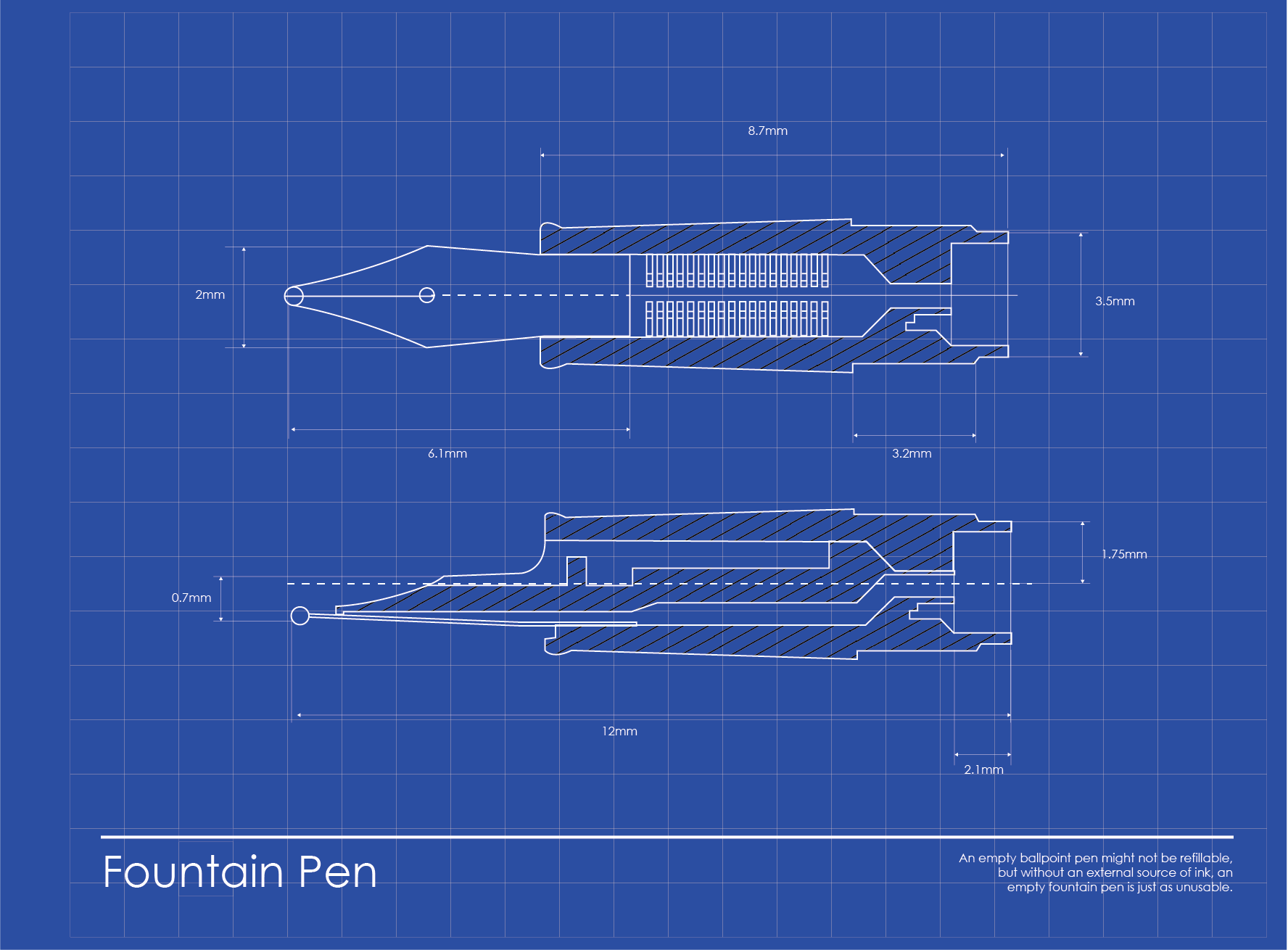
An empty ballpoint pen might not be refillable, but without an external source of ink, an empty fountain pen is just as unusable. Although my eyes had been opened to my need for God, my teen years saw me struggling to embrace the bounty of grace that he offered me. Equipped with the Holy Spirit, I had everything I needed to live a life of freedom — 2 Timothy 1:7 encourages believers that “the Spirit God gave us does not make us timid, but gives us power, love and self-discipline.” When confronted by my sin or other trying situations, I could have thrown myself into his arms, pouring out my heart before him and asking earnestly for forgiveness, healing, his presence… anything. Instead of adopting this trust, I panicked at the fact that I was still failing, that God might think twice about his decision to love me. I found it hard to believe that he could be that generous, and so I shrank back into old habits of fear, control, and scarcity.
As it turns out, he really is that generous. He poured so much strength and love into me during those years, even when I was too steeped in shame and self-reliance to ask for it. That being said, James 1:5 and Matthew 7:11 make it clear how much God delights specifically in meeting our requests, and I could have spared myself a whole lot of pain by taking that to heart. At that point, God was just the extra ink capsule that came with my fountain pen: a comforting backup plan, but not enough to affect my cautious habits. Salvation had given me a fountain pen heart, but it would take years of sanctification before I started treating it like one.
In fact, it took another (equally unusual) summer camp experience. When I was seventeen, I served as a one-on-one caretaker for an incredible man with cerebral palsy, who I was unexpectedly paired with due to a shortage of guy counselors. Just like the last time I was at camp, I knew no one, everyone was coughing, and my routine was completely upside-down — but otherwise, it could not have been more different.
Every morning, after helping my girls’ cabin with showers and dressing, I’d head over to the guys’ cabins, where Matt would meet me with the biggest smile. We quickly learned to work together as the week went on, from communication to the complexities of his wheelchair to the most legendary fist bumps of all time. Before long, I was sleep-deprived from long nights of changing briefs and administering medicines. I was hungry from meals mostly spent feeding Matt. I was sore from lifting, pushing, climbing, and dancing. I was exhausted.
I was used to being exhausted, though. What I wasn’t used to was being so inexplicably happy.
Somehow, in this all-consuming service, I found myself brimming with a bone-deep joy, one that I had never been able to achieve at the average summer camp. Somehow, as my devotion to another person and to God became my singular aim in life, everything else fell away. Self-preservation took a backseat, allowing love to gush forth. I felt the Holy Spirit so tangibly, like ink flowing out of me and into me and out again, like the blood in my veins — no longer stagnant and hesitant, but fresh and breathtakingly alive.
I saw, suddenly, the life I had been invited into all along. For years, I had been secure in my salvation, but I had not been living out my faith to its fullest potential. I had wildly underestimated the magnitude of God, the wisdom and love and courage available to those in his service. I no longer had to fear the life he was calling me to, because walking with him didn’t require righteousness — it enabled righteousness.
The very next Christmas, I got not only another fountain pen (my uncle is legitimately the best), but a bottle of quick-drying ink. I remember watching, flabbergasted, as my uncle stood over the sink and taught me how to refill it. Only then did it occur to me how much more I might have enjoyed my pen if I had known about this, how much more freely I would have written with the ability to fill it again and again.
From that experience, I realized that as Christians, the finitude of life should inspire us to give more, not less. We are alive only in Christ, so everything we have is a gift, and our stewardship is under his terms. Through him, we live life to the fullest, contrary to the picture that society often paints when it comes to organized religion. No matter what we believe, tragedies will continue to disrupt our routine and our sense of security — diagnoses, accidents, layoffs, breakups — but if we walk with Christ, we can make the absolute most of the gifts he has blessed us with. Like writing with a fountain pen, it will be unpredictable and messy, and it will take a lot of practice. But once you encounter the beauty and the freedom of it, you will find it very hard to turn back.
As Paul puts it in 2 Corinthians 3:3, God has given us the chance to be “a letter from Christ… written not with ink but with the Spirit of the living God, not on tablets of stone but on tablets of human hearts.” My short time on earth has shown me a glimpse of the life he originally created me to live, one of such complete communion with him that his will and my will, his hands and my hands, are virtually indistinguishable. Though the process will take my whole life, and not be perfected until he returns, he invites me to leave my scared, small-minded ways, and to live freely, messily, beautifully, for him.
He offers the same invitation to you. Will you take it?