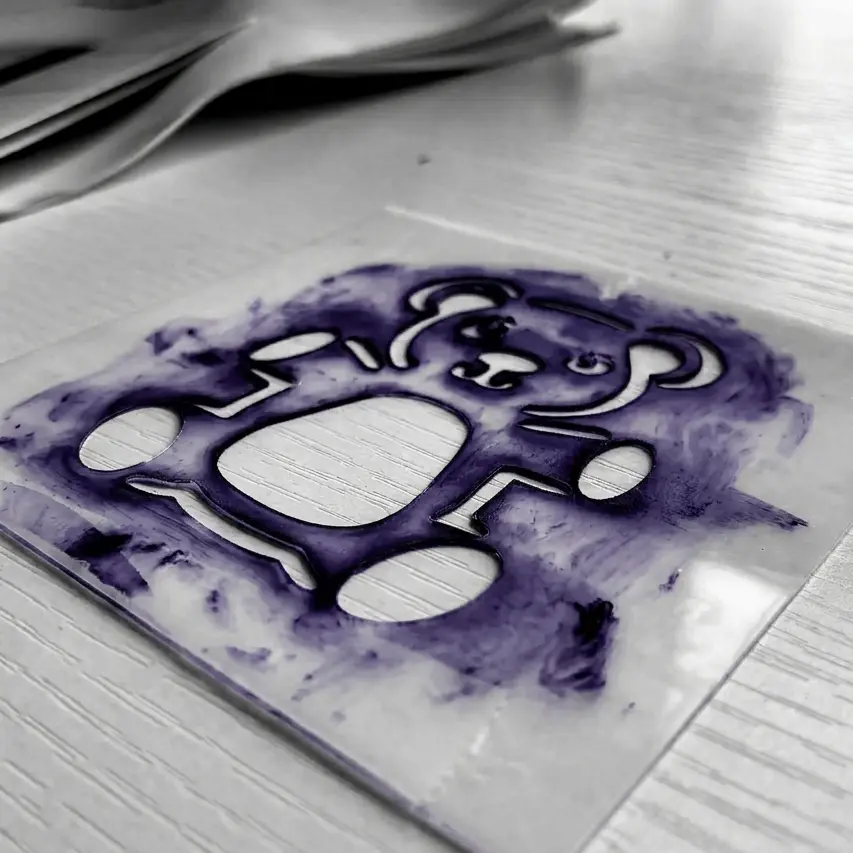
The tape peeled back slowly, resisting at first, clinging to my skin as though reluctant to let go. I drew in a sharp breath, bracing myself, praying the sting would be brief. As I tilted my head up, setting the template beside scattered markers, I caught my reflection. An unguarded smile spread across my face following chuckles of relief. My hand reached instinctively for my phone, and I sent the photo of a small purple teddy bear tattooed on my hip to a man with scruffy hair and soft eyes. I watched the screen glow in dim lighting until his reply appeared.
“I love that you’re mine :)” -Teddy
I then lowered my gaze to the mark I placed and touched it, admiring the deepened love and meaning behind the bear. With my lover, it felt enough simply to know it was there — steady, comforting and familiar knowing that I was his, and he was mine.
For a time, I moved through the days with the quiet awareness of it — a hidden weight beneath fabric, a small certainty carried just out of sight. And each time I undressed and stood amidst my reflection, I could see it, and I could be gently reminded of who I belonged to.
At first it was barely noticeable, a slight blurring as though steam had brushed too closely against it during my showers. The lines lost their sharpness, the color thinning at the corners like watercolor left too long in the rain. I found myself lingering longer in front of mirrors, tilting toward the light, watching the slow undoing while I shifted my posture.
When it nearly vanished, I moved quickly — the clatter of markers, the familiar stencil pressed back against warm skin, the careful tracing of lines I already knew by heart, the brief agony upon removal. The ink returned, darker again, certain again, and the tightness in my chest loosened just enough to breathe.
And everything was fine.
Until it wasn't.
The fading came faster this time, the edges softening before I could forget to look. My hands grew stained in faint streaks of purple, smudges along my fingers, the scent of ink lingering long after I’d capped the pens. A small panic rose quietly, like water filling a room.
Reapply.
Again.
And Again.
And Again.
What had once been occasional became constant — careful tracing turning hurried, the lines growing uneven beneath unsteady hands. The bear returned in shorter and shorter cycles, its certainty slipping further each time as I was desperate to prevent its disappearance.
I searched drawers, surfaces, and the floor beside my bed for any indication of ink, but none were left, and there was nothing left for me to react to.
The last traces faded until only the faintest shadow remained, then nothing at all — just skin, unmarked, as though it had never been there. My eyes had grown dim and I carried a weary heart, anxious for a sign—any sign—of my teddy bear. I checked Whatsapp for the first time in months.
Nothing.
I no longer was his, and he was not mine.
For a while, I stood there with nothing to look at but my own reflection. I kept tracing the space absentmindedly, as though the shape might return if I waited long enough, if I remembered it clearly enough. The place where the bear had once rested felt strangely unfamiliar, bare in a way that made me realize it had become an identity. Without it, I felt lost. Forsaken.
For if I am no longer claimed by him, who do I belong to now?
I kept trying to anchor my identity in things that felt steady at heart– relationships that made me feel chosen, friendships that made me feel understood, achievements that gave me a sense of significance, and hobbies that helped describe who I was. Yet, each of these, no matter how much I invested, faded just as easily as the ink on my skin.
Through these circumstances, I began to understand something deeper about the way we search for identity. People in our culture are looking for two things: purpose and a connection beyond themselves. In other words:
While we often try to answer the first on our own, we tend to look outward to answer the second. That desire for belonging is not wrong. In fact, it reflects something true about how we were made. But when we place the entirety of our identity on things that cannot last — people, labels, objects — those things begin to carry a weight they were never meant to hold.
Community for example can shape us, support us, and walk alongside us, but is not meant to define us completely. The marks we place on ourselves, whether visible or hidden, become attempts to anchor our identity somewhere permanent within a world that is constantly changing.
“For everything there is a season, and a time for every matter under heaven” – Ecclesiastes 3:1
Life moves in seasons uncontrollable, shifting, and never intending to stay. Yet, we still try to etch things eternally in our hearts. The world was never meant to work that way. We were never meant to hold ourselves to what is temporary. When I look at the old stencils that once held my identities, I see my evidence of human longing for permanence in this world.
As time passed and I experienced several grievances, I had to swallow a hard truth. God never promised us a life where everything stays the same, where things don’t fade. But what he does promise is His presence within every season.
Immanuel
It means God with us.
This name given to Jesus was not simply a comforting idea. It was a promise. A declaration of God’s heart toward what is His first. First spoken by the prophet Isaiah in a time of uncertainty, fulfilled in Christ as a living reality. He stepped into fragility to give us guidance on our identity and where we truly belong.
So Immanuel.
God with us.
Not distant. Not fading. Not something I have to hold together.
For so long, I believed belonging was something I could preserve if I just tried hard enough. I hoped if I kept reapplying things I held dear to me like the ink on my skin, that it would just stay, and my identity would stay. I was wrong.
Instead, one of the most heart-warming truths is this: my identity had already been given.
In Ephesians 1:13, we are reminded that our identity is not self-made but sealed by God Himself, for “when you believed, you were marked in Him with a seal, the promised Holy Spirit.”
God had already marked me. Where I feared being unclaimed, he had already spoken about my belonging. And as an everlasting, constant Father, his seal never fades. He is eternal, steady, secure. By His grace, we are already known. Long before we searched for a place to belong, to secure ourselves in something that feels certain, we are already held in his love, which cannot be shaken.
“. . . I have called you by name, and you are mine.” – Isaiah 43:1
This identity does not blur or thin with time. It does not disappear under circumstances. When I look back now, I see that even in the moments when I felt most alone, I was never truly unclaimed. God had already written my belonging into something far more permanent than anything I could create for myself. And how do I know?
“See, I have engraved you on the palms of my hands; your walls are ever before me” –Isaiah 49:16
Engraved. Where my marks fade, His remain.
Where my efforts fall short, His promise endures.
Where I once searched for security in the temporary, I now find rest in the assurance that I am held by the One whose love is everlasting. Because in a world where everything eventually fades, our identity in Christ remains unshaken. So reader, I encourage you to remind yourself who you belong to, for I now look up to heaven with confidence and say,
Lord, I am forever yours.