My future is a blank page, and it terrifies me. Potential may be freeing, but every possibility demands a choice, and that choice can feel damning. From what career opportunities to pursue to tradeoffs between academics and health, our actions echo into the uncharted future. The future is an unsurpassable realm no human effort can breach; it remains dim and dark, just beyond our reach.
Still, what do humans do, when faced with insurmountable and impossible challenges? They struggle. They fight with all their might, no matter the odds. With calendars that dictate our days, plans meant to chart our paths, and societal milestones benchmarking progress in life, we strive. We desperately scrawl our handwriting upon tomorrow’s unblemished pages, attempting to assign an illusion of order to an unstable, unwritten future.
And what results from this endeavor? The careful, tidy boundaries of our calendar dissolve under a wave of waning concentration, unforeseen events, and unrealistic expectations. The simple and idealistic plans of a future career or relationship get derailed by one unexpected decision or one bad call. Reality washes over us and our scribbles upon the page—what had before seemed so neat—now smudges and bleeds.
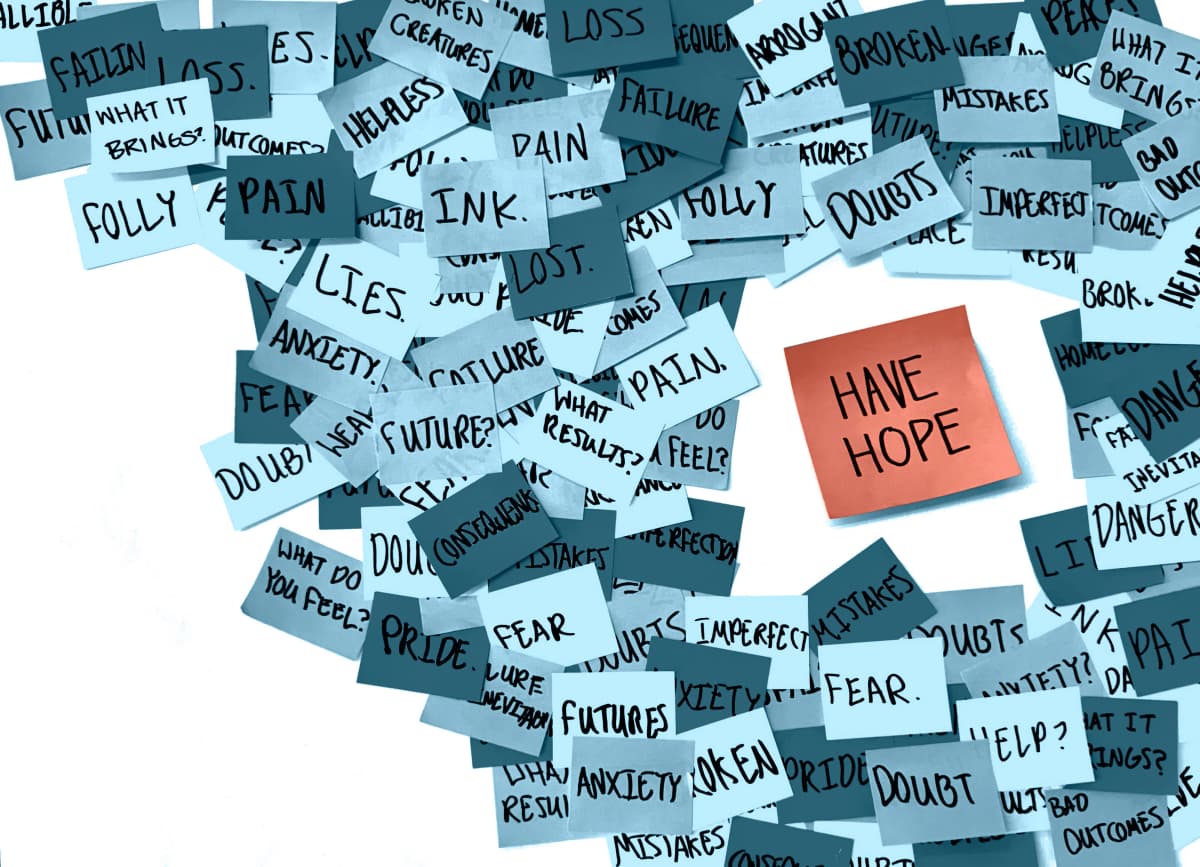
When life robs us of the presumption we know what to expect from it, anxiety sets in. Arising from our expectations of the future, anxiety lives in the gap between where we are now and the outcome we can’t confirm yet. We willingly suffer the tyranny of uncertainty, tormented under a servitude we can’t escape from. Conjuring a future gone wrong, we choose to suffer it in advance.
That was my life for the past few months. I developed a certain ritual: phone before my feet hit the floor, then scan my inbox with bleary eyes. Most mornings brought nothing. Some brought rejections, which I’d learned to grow numb to. The ones that hurt were the others—rejections after interviews I thought went well, impersonal replies from team leads who said we’re excited about you, silence after emails that said next steps. Because those were the mornings where I felt the shame of having hoped, of letting myself build a version of me who figured it out and then having to kill it. Opportunity and belief shriveled, and thoughts spiraled:What if I never get an internship? How will I get a job? I’ll fall behind everyone else. My life will be set back so much. How could I ever catch up? I will be a failure. The despair was more than just about the internship. It was about the narrative I’d been crafting about my own future, about a person who had been given countless chances and wasted them all.
Of course, I sought to escape these thoughts. While searching for answers, hope was a common prescription, and my preferred medication. Have hope in God, I thought. It’ll all work out eventually. I did my best to stay optimistic, trying everything from convincing myself that I didn’t really care about results to deluding myself that it’d all magically work out somehow in the end. But whether anxious or hopeful, I was constantly thinking about the summer and my life ahead.
Perhaps that was the problem. After all, hope, much like anxiety, carries an inherent entanglement with the future. Both involve placing expectations onto future results, and in my head, they often jumbled into one indistinguishable mess. If so, how do we hold onto a hope that remains spotless and will never slip into anxiety?
The first step is to realize that the hope I’d been grasping onto was doomed to fail, because it was rooted in the same fallible mind as anxiety. Blind optimism is no different from blind pessimism. Both lack a solid grounding and involve a delusional cramming of reality into preconceived notions. How then, can we overcome anxiety?
Bet on the fallibility of man.
Our fears and anxieties are the product of a faulty mind, and thus are as prone to failure as anything else we do. My thoughts and feelings of the future are heavily swayed by momentary experiences and subjective beliefs. Based on the fraction of life I’ve experienced, I arrogantly claim to know what paths lie before me, and which narrative fits best. For what is anxiety if not placing some measure of faith into a set of bad outcomes? What is fear but a prideful declaration that I know what my future will hold? Writing a script for ‘happily ever after’, I presume the world will comply with my demands and insist it follow my designs.
When factoring in human imperfection, none of our worries can be trusted. If my thoughts were right, I would never have made it to where I am today. If my fears were as well founded as I believed, I would have flunked every class, ruined every relationship, and ended up as someone who amounted to nothing. Our thoughts cannot be trusted. And so maybe, just maybe, we are not as reliable a narrator of our lives as we think. We may claim to be the author of our lives, but our authorship is flawed.
But the grace of Christianity is that the story doesn’t stop at living with our imperfections. There is another, an infinitely better author, who we can place our hope in.
Hope, for a Christian, is a promise preserved in ink. It stems from pages detailing a covenant with the Almighty and writings that depict the love of a God who died for us. It reassures us that “for those who love God all things work together for good, for those who are called according to his purpose.” 1It provides an assurance that the infinite creator of the universe also intimately loves us more than we love ourselves. And if such a being has “plans for welfare and not for evil, to give you a future and a hope” 2, what are we to fear? Our hope is not rooted in uncertain predictions of the future, but stems from our relationship with a deeply personal God. We entrust the foundation of our faith to the work of a divine author who “has perfected for all time those who are being sanctified” 3.
That perfection, crucially, works through our imperfections, not around them. When I sin, the consequences are permanent. The mistakes I make, written in ink, may remain, but God will use those marks to elevate my story.
The doubts about my future career, the pressures of becoming someone I can be proud of, all magnify the moment when His work is made clear. It was only when I finally gave up control over my summer plans to God that my prayers were answered. The very moment my heart felt at peace with the future was also the moment an offer arrived. Because peace came first, it changed what the offer meant to me. I was able to see the blessing for what it was, not just as a relieved sign that things had finally worked out. I may doubt and I may scheme, yet it is the Lord who establishes my steps. My fears are riddled with flaws, for I simply cannot predict the numerous ways God can move. Even if I fail to recognize the individual strokes of His mercy and grace, they are present, and they will come together to form a future written with purpose.
I trace His fingerprints through my past and witness the subtle threads culminating into who I am today. The rejections. The false hope. The mornings of despair. They’re all in there, seamlessly woven into a narrative I could never have designed. My future is still a blank page, and I still can’t see what it holds. But I know whose hand is holding the pen. And that’s enough.
Footnotes